filter

Country

Region

Sub-region

Producer

Wine type

Volume

Rating

Vintage

Packaging

Price

Contact

Do you have questions or need advice? Get in touch with us directly:

Ask a question

Pomerol

Pomerol lies on the right bank of the Dordogne, north-east of Libourne. Merlot is the principal grape, on a soil of clay and gravel over an iron-rich subsoil known locally as crasse de fer. Pomerol is one of the smallest of the great Bordeaux appellations and has no official classification.

Our range includes wines from Pomerol by producers including Petrus, Le Pin, Lafleur, Vieux Château Certan, La Conseillante and L'Évangile. If you would like to explore Bordeaux further, you will also find Pauillac, Saint-Émilion and Saint-Julien in our range.

Read more

Grape and style

Pomerol is almost synonymous with merlot. Here the grape yields wines that are soft, round and very fragrant, with plenty of structure without becoming hard. Cabernet franc, and to a lesser extent other varieties, supports the merlot with freshness and spiciness.

In the glass you will smell plums, blackberries, truffle, violets and chocolate. The texture is velvety and the finish long. Pomerol is often described as both opulent and elegant.

Location and soil

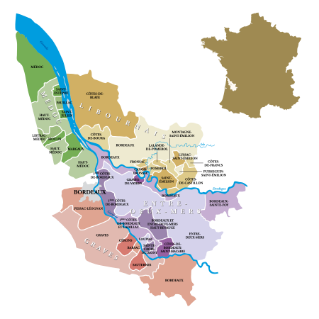
Pomerol is a small area on the right bank of the Dordogne, north of the town of Libourne. The vineyards are spread over a slight rise, with the most famous plots on the highest point of the plateau.

The soil varies greatly. On the plateau the ground is rich in blue clay, which retains water and allows merlot to ripen optimally. Around it there is gravelly and sandy ground. This variation explains differences in style between estates. The neighbouring appellation Saint-Émilion lies directly to the east.

Classification and rules

Pomerol has no official classification of estates. There is no Grand Cru or Premier Cru on the labels: the reputation of a château is built mainly on the quality of its wine and the position of its vineyard.

The appellation rules do apply for grape varieties, yield and method of production. Because the area is small and many estates have only a modest production, the wines are often scarce and highly sought after.

Ageing and serving

Good Pomerol is often approachable after just a few years, but can age for decades. With time the wine develops notes of truffle, leather, dried fruit and forest floor, while the soft texture is retained.

Serve at 16 to 18 °C, young wines decanted if desired. Pomerol goes well with duck, veal, game, mushrooms and soft, mature cheeses.

Producers in our range

These producers feature in our Pomerol range: Petrus, Le Pin, Lafleur, Vieux Château Certan, La Conseillante, L'Évangile, Trotanoy, La Fleur-Pétrus, L'Église-Clinet, Clinet, Le Bon Pasteur, Gazin, Hosanna, Certan de May, Petit Village, Nenin, Clos l'Église, Latour à Pomerol, La Croix de Gay, La Fleur de Gay, Clos René, Le Gay, De Sales and Vray Croix de Gay.
Special bottles

From Le Pin we also have the Trilogie: a case with three consecutive vintages.

More from Bordeaux

You will find more wines from Bordeaux under Pauillac, Saint-Émilion, Saint-Julien, Margaux, Sauternes, Saint-Estèphe, Pessac-Léognan and Haut-Médoc.

News from Vineut

Sign up for the newsletter and stay up-to-date!